
Lighting Basics · 7 min read
How to Choose a Downlight
Wattage and colour temperature are only the beginning. A good downlight also needs the right beam, shielding, output, colour quality and installation detail.
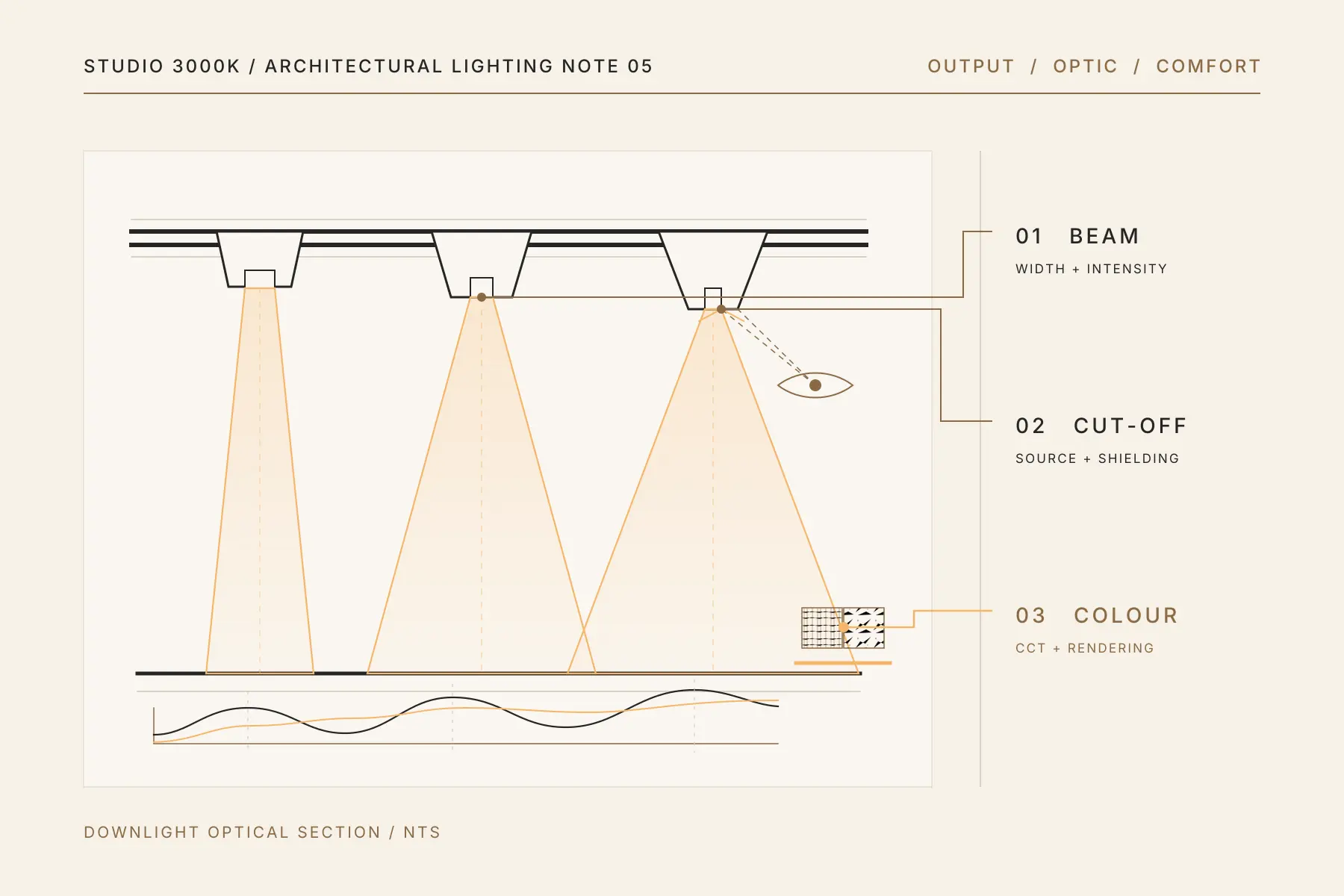
Two downlights can share the same wattage and colour temperature yet produce very different results.
One may spread soft general light across a room. Another may create a tight bright pool. One may keep the source comfortably out of view. Another may feel glaring from the sofa even when it is dimmed.
Choosing a downlight takes more than matching a cut-out size and selecting 3000K or 4000K. The fitting has to suit the job, the ceiling and the way the room will be used.
Start with the purpose
Decide what the downlight is meant to do before comparing specifications.
General lighting needs broad, comfortable coverage. A fitting aimed at art or joinery needs control and often adjustability. A kitchen worktop needs useful light on the surface rather than a bright patch behind the person using it. A corridor may only need even light for safe movement.
The same model does not have to be used everywhere. Consistency is valuable, but it should not override the needs of the room.
If the plan begins with a repeated fitting count rather than clear lighting roles, read the downlight grid problem first.
Wattage, lumens, candela and lux are different
Wattage describes the electrical power used by the fitting. It does not tell you how much useful light reaches the room.
Lumens describe the total light output. Candela describes intensity in a particular direction. Lux describes the light received on a surface. The beam distribution, mounting distance, aiming and surrounding reflectance determine how those values translate into the space.
A lower-output narrow beam can create a brighter centre spot than a higher-output wide beam. A dark room may absorb more light than a pale one. This is why choosing by wattage alone is unreliable.
Use the supplier’s photometric information where it is available, then assess the fitting in relation to the actual ceiling height and target surface.
Beam angle shapes the effect
A narrower beam concentrates light and creates more contrast. It can work well for artwork, objects and focused pools of light. A wider beam provides broader coverage and is often more suitable for general illumination.
The stated beam angle normally describes the main beam, not every trace of spill light. Two fittings with the same nominal angle can still differ in centre intensity, edge softness and overall distribution.
Spacing should follow the beam and mounting height rather than a universal rule. What matters is whether the light overlaps properly on the surfaces that need it.
Glare control is about geometry
Terms such as deep-recessed, darklight and anti-glare can be useful, but they should not be treated as guarantees.
Visual comfort depends on how far the source is recessed, the cutoff created by the reflector or baffle, source brightness, beam direction and the viewer’s position. A well-shielded fitting can still feel uncomfortable if it is aimed towards a normal line of sight.
Look into a working sample from the side, not only from directly beneath it. Sit at approximately sofa or dining-chair height and check whether the bright source remains visible.
Fixed or adjustable
Fixed downlights suit stable tasks and broad general lighting. They create a quieter ceiling and remove the possibility of fittings being aimed inconsistently.
Adjustable downlights are useful when light needs to reach a wall, artwork, joinery or table away from the ceiling point. Check the actual tilt and rotation range, because a nominally adjustable fitting may not aim far enough for the intended target.
Adjustability should have a clear reason. Adjustable fittings only add flexibility when their target is clear.
Colour temperature and colour quality
Colour temperature describes the appearance of the white light. For many homes, 3000K to 3500K works well in living and dining areas, while some homeowners prefer a more neutral 4000K appearance in kitchens and work areas.
Colour Rendering Index, together with information such as R9 where available, helps indicate how naturally materials, food and skin tones may appear. CRI 90 or above is a sensible residential baseline, but specifications should be supported by viewing the light on real finishes.
Adjacent fittings should also match each other. Consistent product families and sensible colour tolerances reduce visible shifts from one source to the next. For a fuller explanation, see what 3000K really means.
Check the physical installation
Before approving a fitting, confirm:
- Cut-out diameter and trim size
- Overall depth and required ceiling void
- Driver dimensions and where it will remain accessible
- Clearance from insulation, structure and other services
- Whether the fitting is fixed, adjustable or replaceable as intended
- Suitability for the exact bathroom, balcony or outdoor location
- Compatibility with any proposed dimming or control system
- Finish consistency across the visible ceiling
A technically good optic is still the wrong product if it cannot be installed, serviced or coordinated cleanly.
Compare working samples, not photographs
Product photographs can show the trim and finish. They cannot reliably show glare, beam softness, colour consistency or how the light affects your timber, stone and paint.
Compare a small number of shortlisted fittings under the same conditions. Keep colour temperature and output comparable where possible, then look at the beam, cutoff and material response. Testing in the intended space is more useful than judging a bright showroom ceiling containing many unrelated sources.
Our note on why lighting samples belong in the space explains how to make that comparison productive.
Choose the downlight whose distribution, comfort, colour and installation detail suit the job.
If you are comparing downlights for a renovation, arrange a lighting consultation with Studio 3000K on WhatsApp.